Imagine walking onto a job site with a massive, heavy toolbox. It has a tool for everything, but it’s clunky, takes forever to unpack, and half the time you can’t find what you need. Now, imagine reaching into your pocket and pulling out a sleek, reliable Swiss Army Knife. It’s compact, versatile, and engineered to handle dozens of distinct problems on the fly.
As certified trainers, we are constantly looking for frameworks that offer that exact kind of utility. We don’t just need content that fills a two-hour workshop; we need ideas that sticky-note themselves to the brains of our participants and change how they actually work every single day.
That is exactly what the Strength Deployment Inventory® (SDI®) represents: the ultimate organizational Swiss Army Knife. But it is only as valuable as your willingness to explore its depth.
To the Beginner: Scratching the Surface
If you aren’t currently utilizing the SDI in your organization, you might see it as just another personality assessment—a “one-and-done” workshop where people learn their colors, put a certificate in a drawer, and promptly forget them.
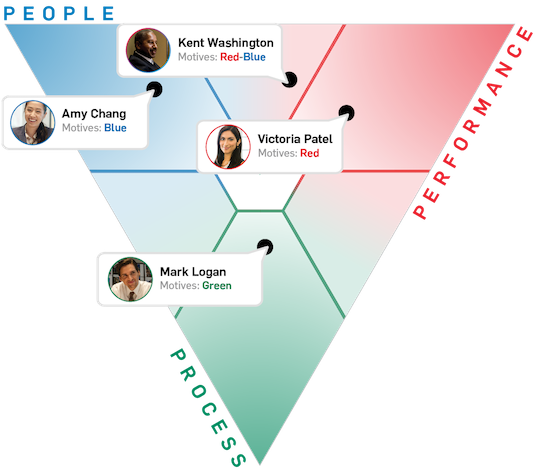
But the SDI is fundamentally different because it doesn’t just measure what people do; it decodes why they do it. By revealing an individual’s Motivational Value System (MVS)—their combination of three core motives driving their behavior (People, Performance, Process)—it hands your learners a universal translator.
When you introduce the SDI to your training ecosystem, you aren’t just teaching communication; you are changing organizational identity. Seth Godin famously noted that culture boils down to a simple shared understanding: “People like us do things like this.” Or, our culture is connected to our actions.
By adopting the SDI, you establish a new standard for what “people like us” do. It empowers individuals by showing them that you can change what you do without changing who you are. In an SDI culture, teammates don’t send blind, data-heavy demands to a relationship-driven colleague. Instead, managers lean on real-time relationship intelligence insights—looking up a teammate’s MVS on the SDI Platform and intentionally adjusting their delivery style before hitting send. The learning lasts because collaboration integrates seamlessly into daily operations.
To the Certified: Unpacking the Hidden Layers
For those of you who are already SDI certified, it’s worth asking: Are you only scratching the surface?
If you only pull out the SDI for team-building workshops, you are leaving the best parts of the framework folded shut. To truly embed that “people like us do things like this” identity into your company culture, you need to start unpacking the platform’s hidden applications across everyday business operations:
- The Conflict Navigator: When departments hit a wall (like Sales vs. Compliance), skip the fluff coaching. Consider building a team Conflict Triangle in the platform to visually demonstrate how everyone moves as conflict begins. You may see that Sales moves immediately to Assert (Red) wanting quick action and resolution, while Compliance drops into Analyze (Green) wanting to think it through logically. It shifts the narrative from “they are trying to block us” to “this is what they need as we navigate conflict.” This is how “people like us” resolve tension without drama.
- The Meeting Mechanics Protocol: Before a critical strategic meeting, teach your teams to look at their team MVS Triangle to spot collective blind spots. If a leadership team is heavily Red/Blue, they can intentionally assign a “Designated Green” role to a team member, explicitly charging them with asking the hard, data-driven questions to encourage the team to slow down and consider the risks.
- The Behavioral Thermostat: In 1:1 leadership coaching, use the SDI to map out top strengths helping a leader achieve results with their team and consider the overdone strengths limiting their effectiveness. Leaders learn to recognize the exact moment their Persuasive nature flips into Abrasive, giving them a tool for self-regulation and strengths-based agility.
Go All In
Whether you are looking to bring the SDI into your organization for the first time or trying to embed it deeper into your daily operations, it’s time to look past the basic profile.
Let’s stop treating relationship intelligence like a workshop topic and start treating it like organizational infrastructure. Your learners don’t need another heavy toolbox. Hand them a multi-purpose tool and teach them how to use it.