



It has been a few years since the last edition of Working with SDI, and a lot has changed since then. As I sat down to draft this third edition, I didn’t just want to update the text; I wanted to evolve it. I wanted to strengthen the connections between the rigorous academic foundations of Relationship Awareness Theory and the real-world application of the Strength Deployment Inventory in organizations. So, after a lot of black coffee, a mountain of academic literature, and some invaluable collaboration, the third edition is finally here. (Available at Amazon)
Whether you’re a long-time facilitator or a manager looking to establish a common language on your team, here’s a look at what’s new, what’s different, and why I’m so excited about this third edition.
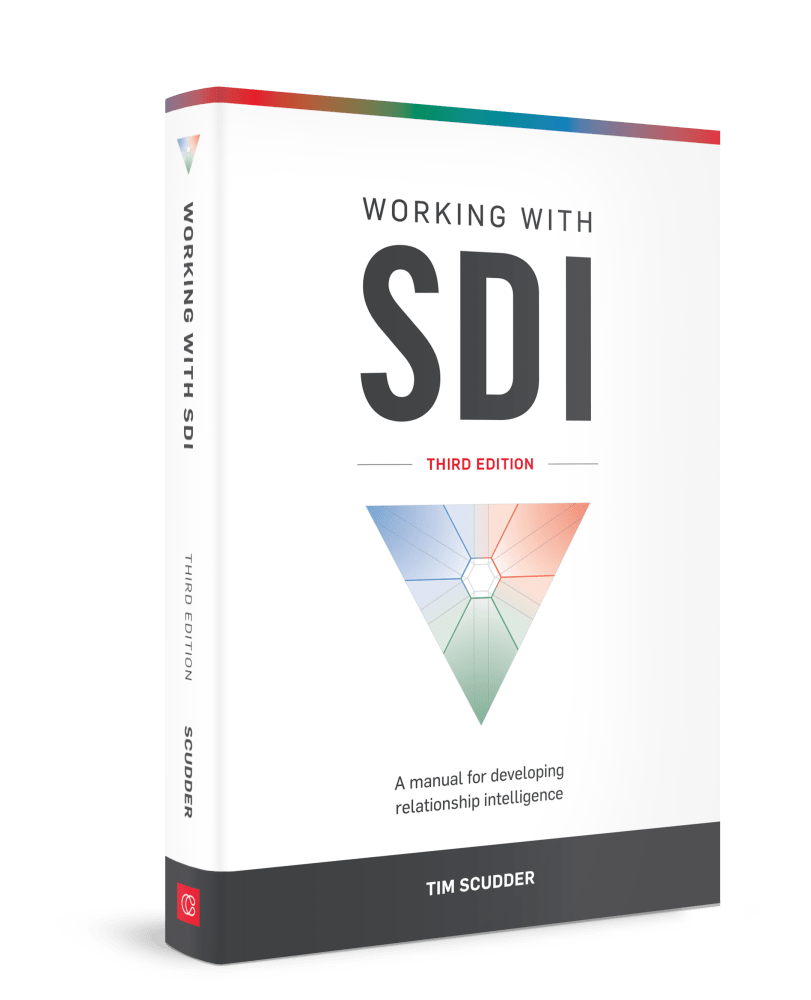
The first thing you’ll notice is the cover. We’ve updated the subtitle: a manual for developing relationship intelligence. You’ll find a new foreword by Ray Linder, whose expertise in personality theory and human development has always been a source of insight for me. The introduction is re-written to speak directly to four specific types of readers: the learner, the manager or leader, the facilitator, and the researcher.
Defining Relationship Intelligence
One notable advance in this edition is the inclusion of my research into Relationship Intelligence. You’ll find the practical application in chapter one, “Insight to Effectiveness,” where I included ideas about how to integrate the SDI into a wide range of training and development programs, and you’ll find support from modern neuroscience in later chapters.
Relationship skills (also known as soft skills) are finally being recognized as the essential skills that make meaningful differences in teams and organizations. I’ve spent the last several years trying to define what it really means to improve a relationship. The quality of a relationship can be evaluated by how favorably we view our past shared experiences, how effective our current interactions are, and how attractive our expectations for the future are. It follows that to improve a relationship, we may need to work in any or all three of these domains—the past, present, and future. Relationship intelligence implies that we can recast the past, master the moment, and co-create the future. And that’s what this book will help you do.
Deep Dives into Personality Types
At the heart of the SDI are two views of personality—the Motivational Value System (MVS) and the Conflict Sequence. In this edition, I’ve added a section that addresses one of the most common questions I get: “Can my MVS and Conflict Sequence change?”
We explain how and why someone might see changes in their MVS and Conflict Sequence, providing a more nuanced look at factors such as maturity, development, increased self-awareness, and situational masking.
Within the MVS type sections, we’ve added a sub-section on decision-making. We look at the types of questions that are top-of-mind for each MVS type as they are making decisions. Blue: “How will others feel about this?” Red: “How do we define success?” Green: “Do we have the proper systems and resources to execute this decision?”
The Conflict Sequence type sections include something I’ve been wanting to do for a long time: expanded path-back statements. All 49 combinations of MVS type and Stage 1 Conflict now have a general description of how the person is likely to see a path to resolution, plus three examples of how they may seek that resolution. For example, here is the one that fits my SDI results:
In Stage 1 Green conflict, a person with a Red-Green MVS will start to see a path back when their analysis reveals a logical justification that makes quick strategic action possible. They will likely strive to:
- Increase efficiency through objective clarification of goals and principles.
- Identify new or missing information that refines the tactical plan.
- Streamline processes by removing an illogical or redundant step.
And yes, there are 48 more of those. Every combination of MVS and Stage 1 Conflict.
For the Theory Geeks (Like Me)
For my fellow academically inclined learners and facilitators, I am most eager to share the new chapter on Relationship Awareness Theory. While Elias Porter’s original theory has always been the bedrock of our work, it deserved a fresh, modern restatement. This chapter presents six premises of the theory:
- Relationships develop over time.
- Motives drive behavior.
- Motives change in conflict.
- Filters influence perception.
- Strengths can be overdone.
- Validity precedes utility.
These simple (slide-friendly) premises are then stated more fully and precisely. For example, the first premise is: Relationships are connections between people constructed from memories of shared experiences, ongoing interactions, and expectations for the future. The theory is rigorously supported and vetted against academic standards about how a personality theory should be constructed and validated.
We’ve also added an appendix, “Foundations and Developments.” This is essentially a curated reading list for anyone who wants to go deeper. It reviews the foundational books and papers that influenced the original SDI, along with several current relevant resources. You can go as deep into the proverbial rabbit hole as you’d like (although you may find yourself in a warren with a fluffle of rabbits).
Better Organization, Better Experience
This third edition is a manual, so you’re probably not going to read it straight through, cover to cover. You’re more likely to jump right into the sections that interest you and then bounce around (like a rabbit). So we made it easier for you to hop right where you want to be.
- The table of contents is more granular and easier to navigate.
- There are robust notes, along with a comprehensive bibliography of works cited.
- A new index of both persons and topics will help you find who or what you are looking for.
- For the first time, we’ve included a list of figures and tables to help you find key ideas or statistics. Where was that table with the stages of conflict by color? What is the test-retest reliability of the SDI?
Closing Thoughts
Writing this third edition felt like the completion of a long-overdue task. It gave me a chance to consolidate what we’ve learned from millions of SDI assessments over the years and distill it into something that is both intellectually rigorous and immensely practical.
The goal remains the same: to help people understand themselves and others so they can relate to one another more effectively. I hope this third edition serves as a powerful guide in your journey toward more productive and rewarding relationships.