
4 Crucial Conversations
for Adopting AI In Healthcare
Silence Kills Miniseries
Every day in healthcare AI is identifying new ways to improve outcomes. But the pace of change depends on how well people handle just a few common but crucial moments.
In a survey of 3,500 caregivers, we noticed a pattern: when caregivers struggle to speak up, innovation stalls and patient safety can suffer. Knowing how to step up to tough dialogue is critical to AI adoption and better healthcare.
Join Joseph Grenny, lead researcher of Silence Kills 2.0 and coauthor of Crucial Conversations, to learn how to navigate four common and crucial moments in healthcare to improve AI adoption, innovation, and patient safety.
Lesson 1
Speak Up
We’ll focus on the first Crucial Conversation in successful AI adoption: Speaking Up. Learn how to raise a concern, share a risk, or signal the need for change when something important is being missed.
Lesson 2
Remind
The second common but Crucial Conversation is: Reminding. Discover how to nudge colleagues when they fall back into old routines instead of using improved ways of working.
Lesson 3
Hold Each Other Accountable
The third Crucial Conversation is Holding Each Other Accountable. Learn how to offer direct, respectful correction when someone dismisses AI innovation, ignores a new standard, or fails to follow through on an agreed practice.
Lesson 4
Challenge Assumptions
Learn the fourth Crucial Conversation: Challenging Assumptions. Adopting new technology requires healthcare teams to examine ingrained habits, beliefs, and routines. Learn how to challenge assumptions in ways that help change take hold—from the top down and the bottom up.
Register Now—It’s Free!
Complete the form and we’ll email you instructions and access to get started.
Select YES in the dropdown field to talk with us about bringing Crucial Conversations for Mastering Dialogue Healthcare into your team or organization.
SEE THE RESEARCH
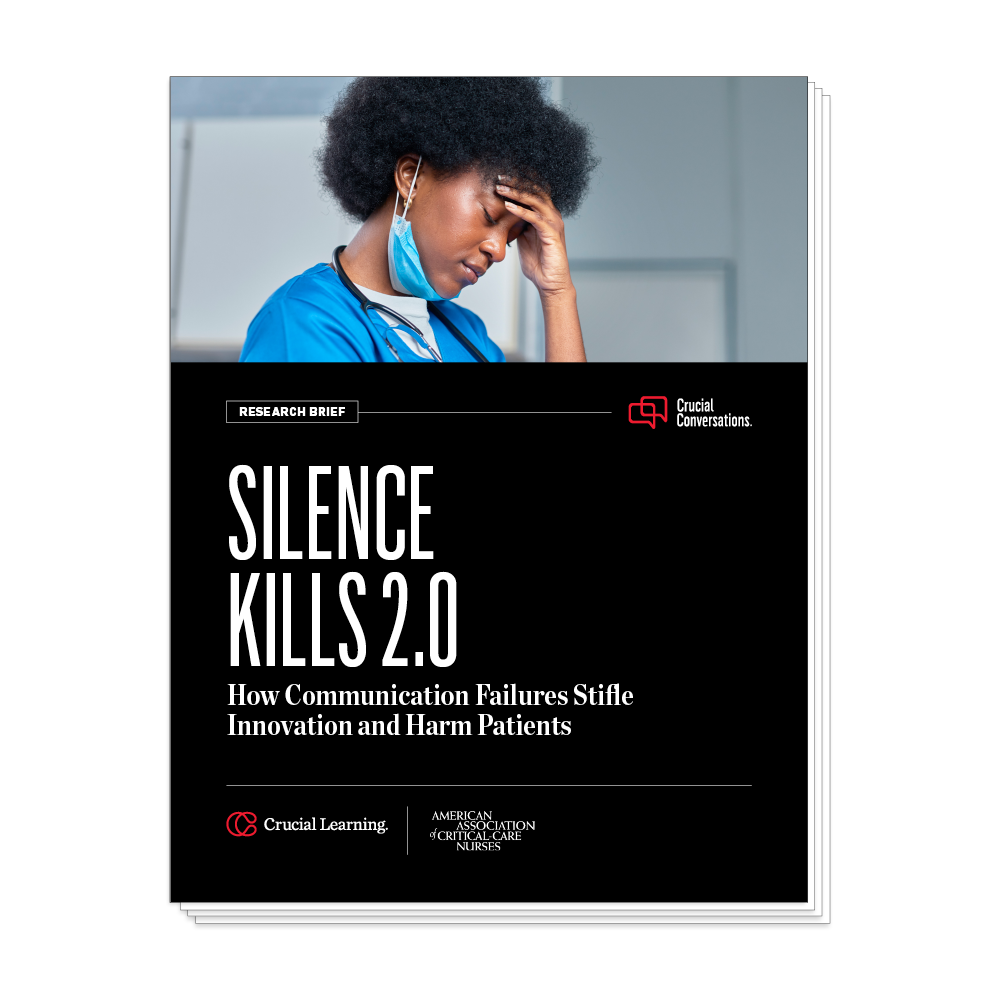
Published in the American Journal of Critical Care, Silence Kills 2.0: How Communication Failures Stifle Innovation and Harm Patients builds on the 2005 Silence Kills research, which examined how caregivers’ ability to handle Crucial Conversations correlated with patient safety, quality of care, and workforce retention.
Two decades later, Silence Kills 2.0 examines whether caregiver communication has improved and how communication patterns are connected to a healthcare system’s ability to innovate. Study sponsors Crucial Learning and the American Association of Critical-Care Nurses surveyed 3,500 caregivers about their ability to speak up across a range of situations, including the adoption of new technologies and evidence-based practices.
The research highlights a practical reality healthcare leaders should recognize: innovation does not succeed by mandate alone. New tools, new practices, and new standards take hold when people know how to raise concerns, remind one another, challenge old assumptions, and follow through in the moments that matter.

MEET YOUR INSTRUCTOR
JOSEPH GRENNY
Joseph Grenny is the cofounder of Crucial Learning and coauthor of several New York Times bestsellers with more than five million copies in print, including: Crucial Conversations, Crucial Accountability, and Crucial Influence. His work has been translated into 28 languages, is available in 36 countries, and has generated results for more than half of the Forbes Global 2000.