

Crucial Conversations
For Mastering Dialogue
The Conversations that Protect Patients
Crucial Conversations® for Mastering Dialogue Healthcare helps healthcare professionals surface concerns earlier, share critical input to improve decision-making, and work better together to provide safer, higher-quality care.









When Concerns Go Unspoken
RISK INCREASES
Healthcare outcomes suffer when people fail to voice concerns honestly and respectfully. Over time, small issues become larger ones, communication breaks down, and opportunities to protect patients are missed.
Crucial Conversations for Mastering Dialogue Healthcare helps clinicians, leaders, and care teams recognize these moments and respond with candor, respect, and confidence—so they can address concerns early and handle the conversations that support safe patient care.
Speak Up Earlier to Address Problems Better
Whether you’re building a stronger culture or helping teams navigate high-stakes situations, these resources offer practical guidance for improving dialogue across healthcare.

Dialogue Heals eBook
Learn practical skills for stepping up to eight crucial but common moments in healthcare that caregivers often struggle to handle well.

Style Under Stress Assessment
Discover how you typically respond when pressure, disagreement, or strong emotions enter a conversation.

Silence Kills Miniseries
Join Joseph Grenny in this free video series to learn how to navigate four common but crucial moments in healthcare—to improve adaptation, innovation, and patient safety.
Adopt New Practices 2x Faster
NEW RESEARCH
Creating a culture where people feel comfortable speaking up improves how organizations respond to risk, adapt to change, and innovate.
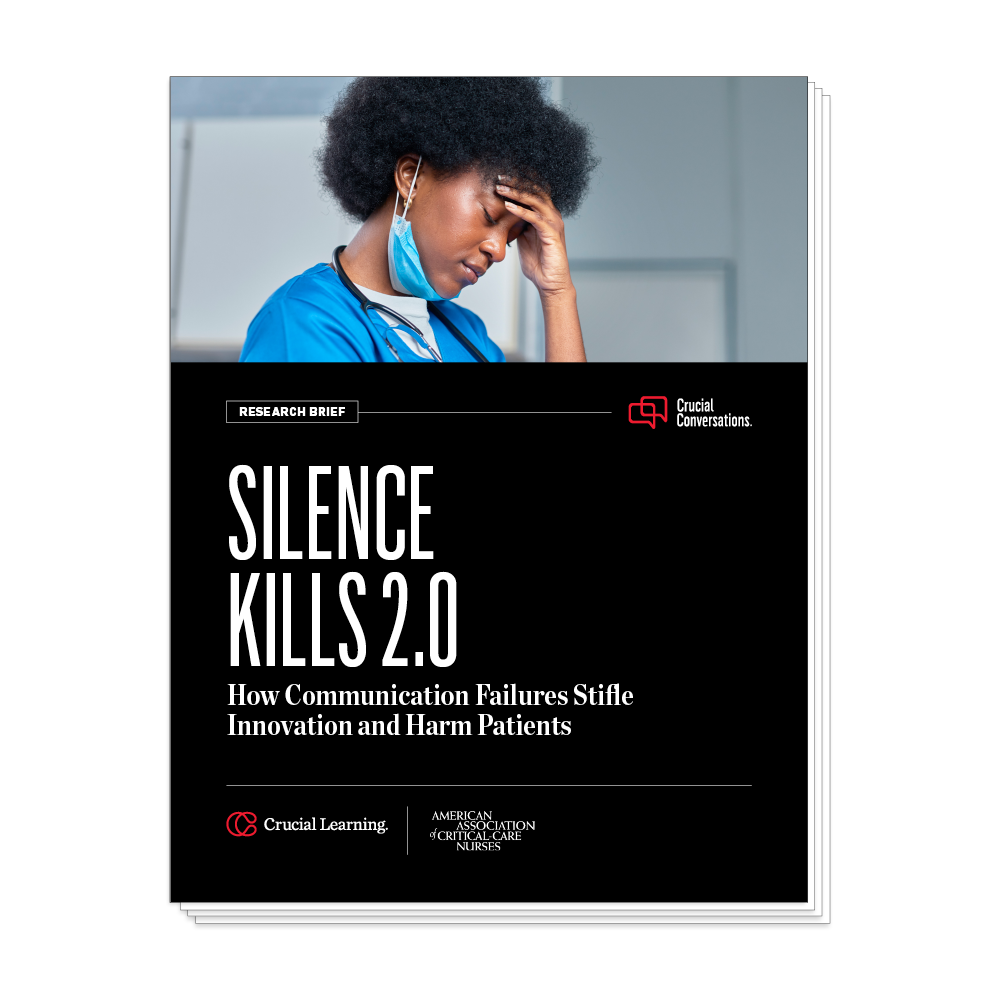
Silence Kills 2.0 shares findings from a national survey of more than 3,500 clinicians examining the relationship between candid dialogue, patient outcomes, and organizational performance. Survey respondents who scored highest on measures of candor reported adopting new clinical practices at more than twice the rate of those who scored lowest.
Oklahoma State University
Center for Health Sciences
See the Impact
in Practice
Watch how Oklahoma State University Center for Health Sciences strengthened staff communication and improved how employees recognized and responded to important issues across the organization. Following implementation, the organization reported statistically significant improvement in employees’ ability to recognize and respond to interpersonal stress, contributing to stronger communication and improvements in patient experience.
Vital Signs of Better Care
Open dialogue helps healthcare organizations create the conditions for safer care, stronger teamwork, and better patient experiences.
Nurses at Spectrum Health reported increased confidence to confront executives and physicians regarding their behavior to improve patient safety.
St. Joseph’s Health Care London earned accreditation with exemplary standing and reduced sick leave from 15 to 12 days.
Maimonides Medical Center reported improved employee morale alongside a 54% improvement in how leaders handled disrespectful behavior.
AORN reported an immediate and significant increase in nurses’ confidence and ability to address disruptive physician behavior.
Employees at MaineGeneral Health were 167% more likely to speak up and resolve problems with colleagues following training.
Explore Solutions
Create an environment where healthcare professionals raise concerns early, address issues directly, and work together to improve patient care.
Connect with a client advisor to explore how Crucial Conversations® for Mastering Dialogue Healthcare can support your organization.
Designed For Healthcare
From patient safety concerns to difficult interactions between colleagues, healthcare professionals face high-stakes conversations every day. This healthcare-specific learning experience uses realistic scenarios and hands-on practice to help participants communicate effectively when it matters most.
4 Mins Video
Learning Formats
The course teaches practical skills for recognizing when patient care, teamwork, or safety may be at risk—and responding in ways that keep dialogue open and respectful problem-solving intact.
1. Get Unstuck and Master My Stories I
Spot the conversations that are keeping you from what you want.
Choose the right conversation to get unstuck.
Learn where emotions come from and how to change them.
Take responsibility for the emotions you bring to the conversation by owning your story.
2. Master My Stories II and Start With Heart
Eliminate negative stories that impede conversations and results.
Stay focused on what you really want.
Lay a foundation of good intent.
3. State My Path and Make It Safe
Speak honestly and respectfully.
Share tough messages in a way that invites others into the conversation.
Take steps to rebuild safety when others get defensive.
Talk with almost anyone about almost anything.
4. Learn To Look and Seek Mutual Purpose
Notice the signs that people are not in dialogue.
Identify and manage your own Style Under Stress.
Recognize when safety is at risk because you’re at odds.
Find common ground even when it seems impossible.
5. Explore Others’ Paths & Move To Action
Actively listen to understand the meaning behind others’ emotions and actions.
Respond productively when someone initiates a Crucial Conversation with you.
Move from healthy dialogue to taking action and achieving results.
1. Get Unstuck
- Spot the conversations that are keeping you from what you want.
- Choose the right conversation to get unstuck.
2. Master My Stories I
- Learn where emotions come from and how to change them.
- Take responsibility for the emotions you bring to the conversation by owning your story.
3. Master My Stories II
- Eliminate negative stories that impede communication and results.
4. Start With Heart
- Stay focused on what you really want.
- Lay a foundation of good intent.
5. State My Path
- Speak honestly and respectfully.
- Share tough messages in a way that invites others into the conversation.
6. Make It Safe
- Take steps to rebuild safety when others get defensive.
- Talk with almost anyone about almost anything.
7. Learn to Look
- Notice the signs that people are not in dialogue.
- Identify and manage your own Style Under Stress.
8. Seek Mutual Purpose
- Recognize when safety is at risk because you’re at odds.
- Find common ground even when it seems impossible.
9. Explore Others’ Paths
- Actively listen to understand the meaning behind others’ emotions and actions.
- Respond productively when someone initiates a Crucial Conversation with you.
10. Move To Action
- Move from healthy dialogue to taking action and achieving results.
Upcoming Courses

BASED ON THE BESTSELLER
For more than two decades, Crucial Conversations has helped millions of people navigate conversations where stakes are high, opinions differ, and emotions run strong. The healthcare course builds on these proven principles with clinical scenarios, examples, and practice designed for the realities of patient care.


